
Pick Your Tokyo Basho and Sale Date (Time Zones Included)
Tokyo hosts three of the six grand sumo tournaments each year, called basho, in January, May and September. Each runs 15 days, starting and ending on a Sunday (The Real Japan). Nearly everyone buying ryogoku kokugikan tickets is aiming for one of these three windows, so your first decision is which one fits your trip.
For 2027, the Tokyo dates are Hatsu, January 10–24, Natsu, May 9–23, and Aki, September 12–26. Osaka (March), Nagoya (July) and Fukuoka (November) fill the gaps. If your trip lands in one of those months, there’s no Tokyo basho to attend. Check the calendar before you book flights, not after.
Next, lock in the on-sale date. Advance sales always open on a Saturday. The January 2027 sale opens on December 5, 2026, and the March sale opens on February 6, 2027 (Watabi, corroborated by Enjyu Japan). The English sale opens at 10:00 Japan time, which falls at a very different hour depending on where you live. Here’s a quick conversion for a standard 10:00 JST start, using standard time (shift by an hour if daylight saving applies on the day):
- US Pacific: 5:00 p.m. the previous day (Friday)
- US Eastern: 8:00 p.m. the previous day (Friday)
- UK (GMT): 1:00 a.m. Saturday
- Central Europe: 2:00 a.m. Saturday
- Australia (Sydney, AEDT): midday Saturday
Set an alarm and double-check the conversion for your own date, since daylight saving can move it by an hour. Official sales run first-come, first-served, so a few minutes can matter.
Why Sell-Outs Happen: The Lottery Rounds Explained
Ever opened the official English site a few minutes after the sale started and found nothing? You weren’t slow. You were late to a process that had already run several rounds before you arrived.
Before the general sale come lottery presale rounds, and foreign visitors usually can’t enter them. They typically require a Japanese address, a Japanese phone number for SMS verification, and payment at a Japanese convenience store within 48 hours (Next Destination). The general sale is effectively the last round, after four lotteries have already claimed their share of seats. That’s why a tournament can look wide open on paper yet sell out within the first morning of public sales, which has been the pattern for recent Tokyo tournaments.
The English general sale has no lottery. It’s first-come, first-served from 10:00 JST, with a maximum of four tickets per order for the same date and category. So the realistic way in is to be ready the minute the sale opens, with your account created, your card tested and your seat plan already decided.
Adjust your expectations, too. The popular days, especially weekends and the final days of a tournament, go first. Midweek days in the middle of the basho are often easier, and the sumo is wonderful on any day. If your dates are flexible, aim for a weekday and keep a second date in mind.
Buying Through the Official English Sale, Step by Step
The official English sale is Ticket Oosumo (sumo.pia.jp/en), run by the Japan Sumo Association’s ticket agency (Koyomi Japan). It’s the cleanest route to ryogoku kokugikan tickets, so prepare properly.
Before sale day:
- Create your account on the English site ahead of time, not during the rush.
- Ask your card issuer to allow international online payments. The site takes credit cards only, and a card that fails its 3D Secure check while you’re abroad can stop the purchase cold. Make sure your phone can receive the verification message or app prompt wherever you are.
- Decide your first and second choice of date and seat category, so you aren’t deliberating while seats vanish.
- Open the page a few minutes early and stay logged in.
On sale day:
- Select your date, seat type and number of tickets (up to four).
- Enter your payment details and complete the 3D Secure step.
- Save the confirmation and the voucher number you receive.
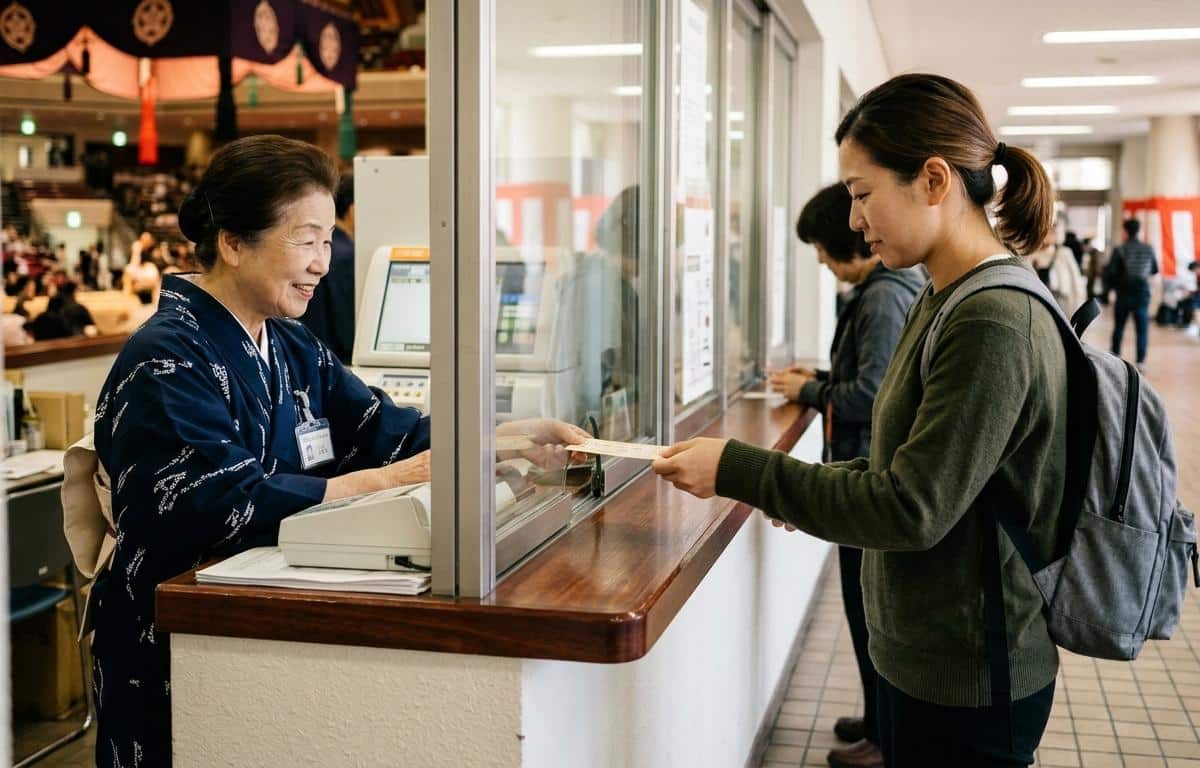
After purchase: This part surprises many visitors. Tickets aren’t e-tickets. They’re printed at Seven-Eleven stores in Japan and collected with a voucher number (Sumo Sumo Sumo). You need to be in Japan to receive them, so plan a quick convenience-store stop before the day. Also note that Ticket Oosumo doesn’t allow refunds or date changes after purchase (Fuji Wellness), so confirm your date carefully before you pay.
For the broader picture of buying live-event tickets from abroad, our guide on how to buy concert tickets in Japan as a foreigner covers many of the same payment and pickup hurdles, and our step-by-step sumo tickets guide goes deeper on the whole process.
On price, tickets for 2027 Tokyo are rising, while Nagoya and Kyushu are unchanged (Tachiai). Categories and amounts can shift, so check the official site for current figures rather than trusting any number quoted elsewhere. A per-ticket service fee also applies on the English site, so look at the total at checkout.
Choosing Your Seat: Chair, Box, and Ringside Naming
Seat naming trips up a lot of first-timers, because the English site and older guides use different words for similar things. The arena at Ryogoku is a two-story hall: Japanese-style floor seating on the first level, chairs above. You can read more about the building on our Ryogoku Kokugikan venue page.
Chair seats are the upper-level seats with a normal chair, sorted by distance from the ring, with prices falling as you move back. They’re the comfortable choice if you dislike sitting on the floor, and the sightlines in a well-designed hall like this are good even from the back.
Box seats (masu) are the traditional square cushion boxes on the first floor, seating up to four people. You take off your shoes and sit on the floor, which is part of the atmosphere. They suit groups and anyone happy to sit cross-legged for a few hours. They can feel snug for tall travellers.
Tamari are the ringside cushion seats right beside the dohyo, the clay ring. They aren’t sold through the English general sale, only through the Japanese portal (Next Destination). Some guides suggest they’re largely held for patrons and VIPs, so treat them as unlikely for foreign visitors on the open sale.
The English purchase flow lists categories as Chair or Box in tiers such as S, A, B and C, which can read differently from the older chair-and-box wording. In short, the tiers are about proximity and price, while "chair" versus "box" is about how you sit. For a first visit, a mid-level chair seat is often the sensible balance of view, comfort and cost.
If Sales Are Gone: Comparing Concierge, Package and Resale Routes
If the general sale sells out before you get through, you still have options. Each trades some certainty or cost for access, so know what you’re choosing between.
Same-day tickets at the venue. A limited number of tickets may be offered on the day. Reports conflict on timing and availability, so treat this as a possibility, not a plan, particularly at the busiest tournaments.
Hotel concierge. Some hotels will buy on your behalf if you’re staying with them. It’s convenient, but availability depends on what the hotel can still obtain, so ask in advance what fees and delivery arrangements apply.
Tour or experience packages. These bundle a seat with transport, a guide or a meal, and are often the simplest way to attend with no Japanese-language steps. They typically cost more than a bare ticket, since you’re buying the package, not the face value of the seat.
Concierge and personal-shopper services. A Japan-based service registers, buys and arranges delivery for you. This is where we can help: at Jasumo Events we purchase on your behalf and verify tickets before delivery, with English support. You can see how we work and browse our sports tickets. We can’t guarantee any particular seat or date, so ask what’s available for your tournament.
Resale. Resale marketplaces sit outside the official route, and prices and conditions vary. We couldn’t confirm the Sumo Association’s exact wording on resale, so check its guidance yourself and compare the total cost, including fees, before committing.
How to choose
Choose by what matters most to you:
- Lowest cost, and you can be online at sale time: the official English sale.
- You can’t be awake at the sale hour, or the Japanese steps worry you: a concierge or purchasing service.
- You want no logistics at all: a package that includes the seat.
- Your dates are fixed and sales are gone: compare the total cost, refund terms and delivery method of each fallback before paying.
Whichever route you take, remember there are no refunds or date changes on the official site, and plan your Seven-Eleven pickup. If you’re building a wider Tokyo itinerary, our Tokyo events page lists what else is on during your stay.

