
Know the Tokyo Basho Dates and Sale Days
Grand sumo holds six 15-day tournaments a year, and Tokyo hosts three of them: January, May and September, according to Rakuten Travel’s Tokyo sumo guide. Osaka, Nagoya and Fukuoka take the other three. If you want sumo tickets in Tokyo, your trip has to land inside one of those three windows. Outside them, nothing is happening at the Ryogoku arena.
The next Tokyo basho is Hatsu, January 10 to 24, 2027, per Japan Event’s 2027 schedule. Every tournament starts and ends on a Sunday, so you can fit a full weekend of bouts around either end. A few older pages list January 11 to 25 for 2026, so check the official calendar before you book flights.
The on-sale date matters far more than the tournament date. Advance sales always open on a Saturday, and two sources agree on the dates for January and March 2027, as reported by Watabi’s ticket guide: December 5, 2026 for January, and February 6, 2027 for March. The 10:00 AM Japan time start is what trips up overseas readers. Confirm the exact local time for the next sale on the official site shortly before it opens.
If you want the venue basics first, our page on Ryogoku Kokugikan covers where you’ll be sitting, and our sports tickets section lists other live events you can add to the trip.
Why Lotteries Make Sell-Outs Likely
Here’s what surprises most first-timers: the sale you can actually join isn’t the first one. The official route is Ticket Oosumo English at sumo.pia.jp/en, which, as Koyomi Japan explains, is the Association’s official seller, run by Ticket Pia. But earlier presale rounds happen on the Japanese side before the English sale opens.
Those earlier rounds are lotteries, and they ask for things most visitors don’t have: a Japanese home address, a Japanese phone number for SMS verification, and payment at a Japanese convenience store within 48 hours, according to Next Destination’s buying guide. One source counts the English general sale as the fifth round, after four lottery rounds. By the time it opens, a large share of the best seats is already spoken for.
The English general sale has no lottery. It’s first-come, first-served from 10:00 JST, capped at four tickets per order. That sounds fair, and it is, but demand is intense. Ozumo.jp reports that every day of the September 2026 Tokyo tournament sold out on the morning the general sale began. The November 2026 Kyushu basho also had no same-day sales because it sold out, as noted by Sumo Sumo Sumo’s visitor guide.
So set your expectations accordingly: if you show up late, you’ll probably see "sold out." You didn’t do anything wrong. That’s simply how the system works, which is why sale-day preparation and a solid fallback plan matter so much.
Your Sale-Day Checklist Across Time Zones
The sale opens at 10:00 AM in Japan, which is an awkward hour for anyone outside Asia. For North America and Europe it’s generally evening or the middle of the night, and in Australia it may fall at a very different time. Convert it carefully with a world clock, and remember you’re converting Japan Standard Time, which doesn’t observe daylight saving.
Here’s a practical checklist, roughly in order of importance:
- Create your account on the English official site before sale day, not during it, so you aren’t typing details while seats vanish.
- Check that your credit card works for international online payments. The English site takes credit cards only, per Japan Event, so cash and bank transfers are out.
- Budget for a ¥2,000 service fee per ticket on top of the seat price.
- Set up any 3D Secure or one-time-password step with your card issuer in advance. A failed verification at the last second can cost you the seat.
- Pick your target date, seat category and a backup date before the sale opens. You only get a few minutes.
- Remember the four-ticket limit per order, for the same date and category. A group of six needs two orders.
- Open the page a few minutes early and refresh at 10:00 sharp.
Tickets are non-refundable and non-changeable once bought, so only book dates you can truly commit to. And if a 3 AM alarm sounds miserable, a concierge route (covered next) is a perfectly reasonable alternative.
Official, Concierge or Resale: Cost and Risk Compared
There are three ways to get sumo tickets in Tokyo, and each trades money against risk.
Official purchase is the cheapest and safest. You pay face value plus the ¥2,000 per-ticket fee, and you get genuine tickets straight from the Association’s seller. The catch is that success comes down to timing and luck, so it suits travelers who can be awake at the right hour and have a flexible backup plan. Nothing is marked up.
Concierge or personal-shopper services sit in the middle. A Japan-based person, a hotel concierge or a ticketing helper registers, buys and prints on your behalf, as Sumo Sumo Sumo notes when it mentions hotel concierges. Expect a service charge. This route works well if time zone, language or card problems keep you out of the sale. Its strength is convenience, and the risk is moderate as long as the provider is clear about what you’re buying.
Resale carries the highest cost and the highest risk. Tickets are non-refundable and non-changeable, and the official route is the only one the Association controls. Watabi’s guide describes the resale trap in detail, and Ozumo.jp notes that marketplaces, tour packages and travel agents all sit outside the official route. That warning comes from secondary sources, so check the Association’s own wording if you want certainty. Treat resale as a last resort, and only through a seller that verifies tickets before delivery.
Prices are shifting too. The Association has announced increases for Tokyo and Osaka tournaments, with Nagoya and Kyushu unchanged, according to Tachiai’s July 2026 news update. Verified 2027 figures aren’t confirmed here, and even the cheapest seat price is reported inconsistently across sources. Check the official site for current numbers rather than trusting any single article.
Getting Your Tickets Printed and Choosing Seats
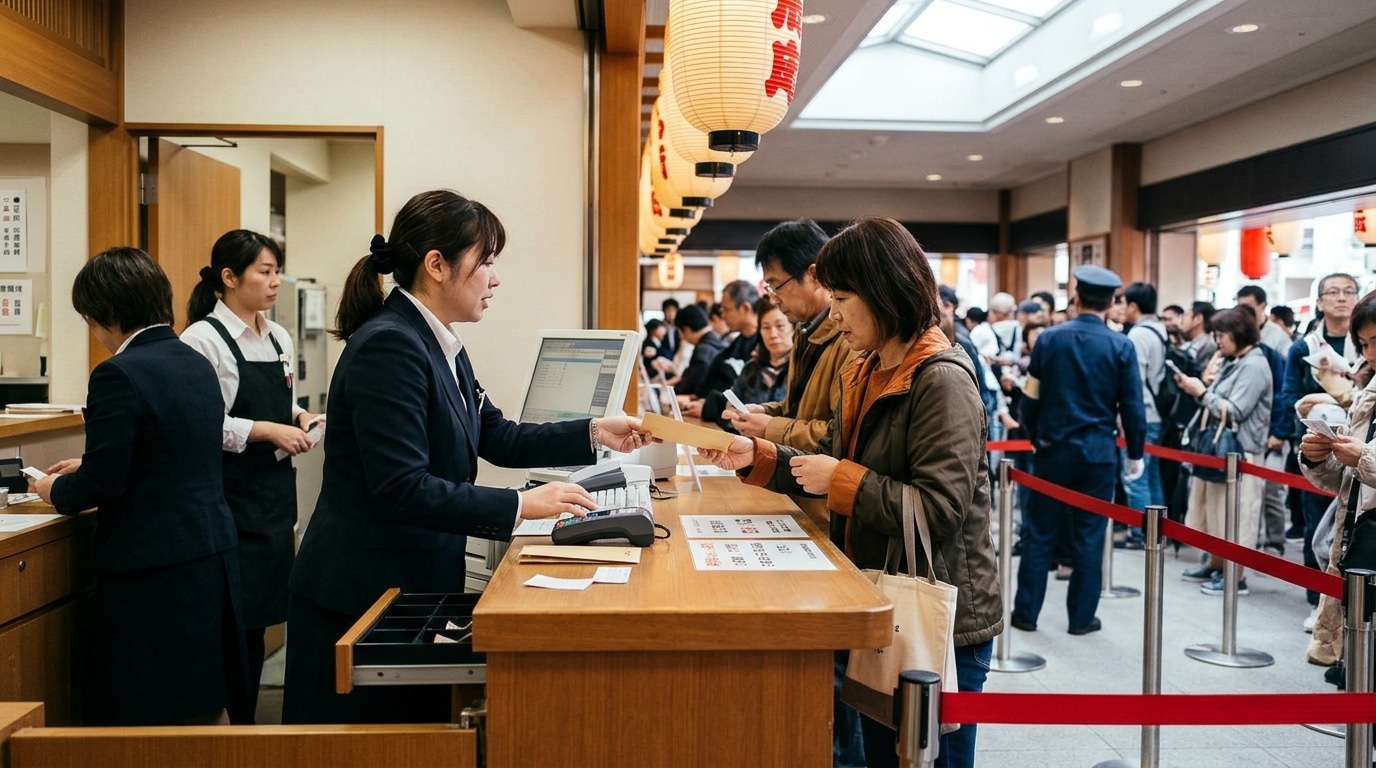
Many visitors expect an e-ticket, but that’s not how this works. Tickets are printed at Seven-Eleven stores in Japan, per Sumo Sumo Sumo, and Next Destination adds that you collect them with a 9-digit voucher number. Do you need to be in Japan to receive them? In practice, yes. The printing happens in Japan, so if you’re abroad when the sale opens, you’ll have to print after you arrive or ask a Japan-based helper to do it. Keep the voucher number safe and screenshot it.
Once you have a ticket, it’s valid for the whole day, with one re-entry allowed before 5:00 p.m., per Rakuten Travel. Arrive early: the lower-ranked bouts start in the morning, and the top ranks wrestle in the late afternoon.
Now the seats. The arena has two stories, with Japanese-style floor seating on the first floor and chairs on the second. Floor seating means taking off your shoes and sitting on cushions, which suits small groups who don’t mind sitting low. Chair seats are much easier on the knees and make the sensible pick for first-timers, taller visitors and anyone with mobility concerns. Naming varies by source, with some describing chair categories and box categories lettered S, A, B and C, so read the labels carefully at checkout.
Ringside tamari seats often aren’t sold on the English site and tend to go to sponsors and patrons, so don’t build your trip around getting one. Wheelchair booking is reportedly handled by phone in Japanese, so ask your hotel for help early.
If the official sale is gone, browse our other event listings or read about Jasumo Events for a verified route, and see the FAQs for common ticketing questions. Same-day tickets at the venue are possible in some cases, but sources conflict, so treat them as a bonus rather than a plan.

